
The Wellness Buzzword Checklist: How to Tell If Health Claims Are Actually Backed by Science
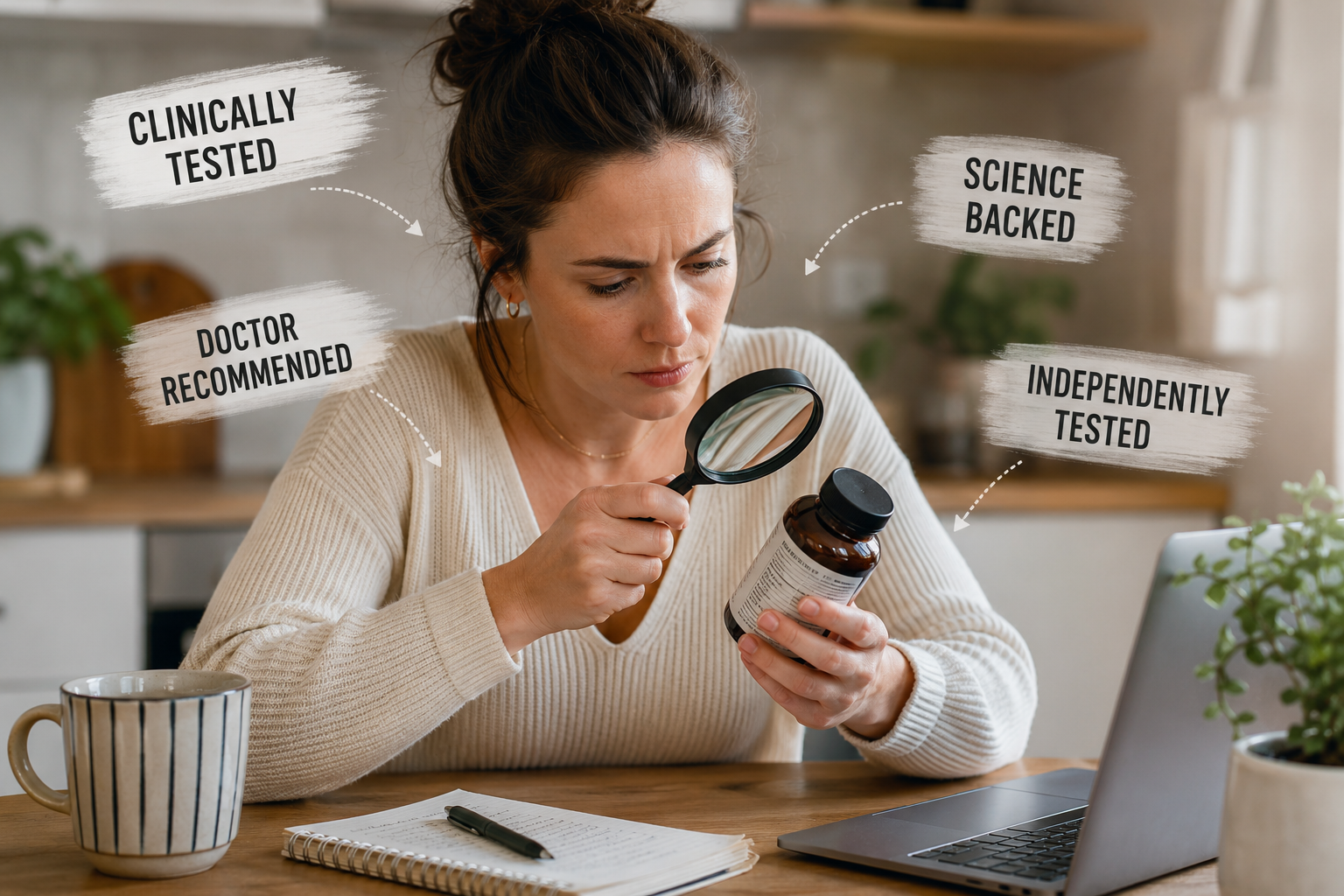
Walk down the supplement aisle, scroll through a wellness influencer's page, or read the label on a skincare product, and you'll encounter the same handful of phrases again and again. "Clinically proven." "Doctor recommended." "Backed by science." "Independently tested." These phrases are doing a lot of work. They're designed to short-circuit the part of your brain that would otherwise ask, "Wait, proven how, exactly?" And for the most part, they succeed, because the words sound precise and technical even when the substance behind them is thin.
This isn't necessarily because every wellness brand is lying. Sometimes there's real research behind a product. But the gap between what a phrase like "clinically tested" implies and what it actually guarantees is often much wider than most readers assume, and closing that gap is one of the most useful skills a health-conscious consumer can develop.
Why "Clinically Tested" Doesn't Always Mean What Readers Think
When most people read "clinically tested," they picture something like a rigorous drug trial: hundreds of participants, a control group receiving a placebo, researchers unaware of who's getting what, and results reviewed by outside experts before publication. That is what clinical testing can mean. It's rarely what it does mean on a product label.
In reality, "clinically tested" can be a surprisingly vague phrase in wellness and cosmetic marketing. Depending on the product and the claims being made, the phrase may describe a relatively small study involving a limited number of participants, conducted over a short period, with no control group, no blinding, or no peer review. The phrase tells you a test happened. It tells you almost nothing about whether that test was designed well enough to actually prove the product works.
There's also a meaningful difference between testing a product's safety and testing its effectiveness. A moisturiser might be "clinically tested" purely to confirm it doesn't irritate skin, a reasonable and useful safety check, while the marketing around it implies the testing proved its anti-ageing claims. Reading the fine print, when there is any, often reveals which type of testing actually took place. None of this means clinical testing is meaningless.
Well-designed studies, published in reputable journals and involving enough participants to draw meaningful conclusions, can provide valuable evidence. The issue is that the phrase alone can't tell you which kind of study you're dealing with. The label sounds the same whether the underlying research was rigorous or barely more than a friendly experiment among a company's own staff.
“The phrase tells you a test happened. It tells you almost nothing about whether that test was designed well enough to actually prove the product works.”

What Independent Testing Actually Tells Us
"Independent testing" is another phrase that carries more weight than it deserves. The important question is not simply whether a different organisation conducted the test, but who commissioned it, who paid for it, what was tested, and how the results were reported. That distinction matters enormously, because research funded by the company selling a product tends to produce more favourable results than research funded by neutral parties, a pattern well documented across pharmaceutical research, nutrition science, and consumer products alike. This isn't necessarily due to outright dishonesty; it's often a product of subtler biases, like which outcomes get measured, which results get published, and how questions get framed.
Genuinely independent testing usually comes from a few recognisable sources: university researchers without financial ties to the company, government health and safety bodies, accredited third-party laboratories with no commercial relationship to the product, or nonprofit consumer research organisations. The absence of a direct commercial stake can make their findings easier to evaluate independently.
It's worth being alert to a specific kind of blurring that happens in wellness marketing: a company will commission testing from a lab, then describe the results as "independently verified," implying neutrality that doesn't quite exist. The lab may be technically separate from the company, and the testing itself may even be conducted competently, but if the company chose the lab, paid for the study, and controlled what gets published, the independence is more limited than the phrase suggests.
Real independence includes not just who runs the test, but who decides what to do with the results. And independence is only one part of the picture. Even when a study is legitimate, the way its findings are translated into marketing can change how much certainty a reader thinks the evidence provides.
“Real independence includes not just who runs the test, but who decides what to do with the results.”
How to Distinguish Marketing Language from Scientific Evidence
Marketing language and scientific language often use similar vocabulary while communicating very different levels of certainty, and learning to spot the difference is a genuinely useful literacy skill. Scientific language tends to be cautious and specific. Developing this kind of critical reading is part of building healthier long-term habits, not just avoiding misleading products. It talks about "a statistically significant reduction in X among participants in a controlled study," names the sample size, describes the methodology, and acknowledges limitations. Marketing language tends to be confident and vague. It talks about products that "support," "boost," "detoxify," or "optimise" without ever specifying what was measured, how much change occurred, or compared to what baseline.
There’s another question worth asking: evidence for what, exactly? A study might support the safety of an ingredient without showing that it produces the advertised benefit. Research conducted in animals may tell researchers something useful without establishing that the same effect occurs in humans. And evidence for one specific outcome doesn’t automatically support every claim made around a product.
A few patterns are worth watching for. Words like "support" and "promote" are doing quiet work; "supports immune health" is a claim that's almost impossible to disprove and rarely backed by the kind of evidence a stronger claim like "reduces cold duration by two days" would require. Specificity doesn’t make a claim true, of course, but it makes the claim concrete enough to investigate. Testimonials and before-and-after photos are compelling storytelling tools, but they are not evidence in any scientific sense; a handful of satisfied customers says nothing about how a product performs on average, or whether the outcome was caused by the product at all rather than diet, lifestyle changes, or a simple placebo effect happening alongside it.
References to "studies show" without naming the study are another common flag. Real research can be named, dated, and looked up. A vague appeal to unspecified studies is often a sign there's nothing specific to point to, or that the study in question wouldn't hold up well to scrutiny if named directly.
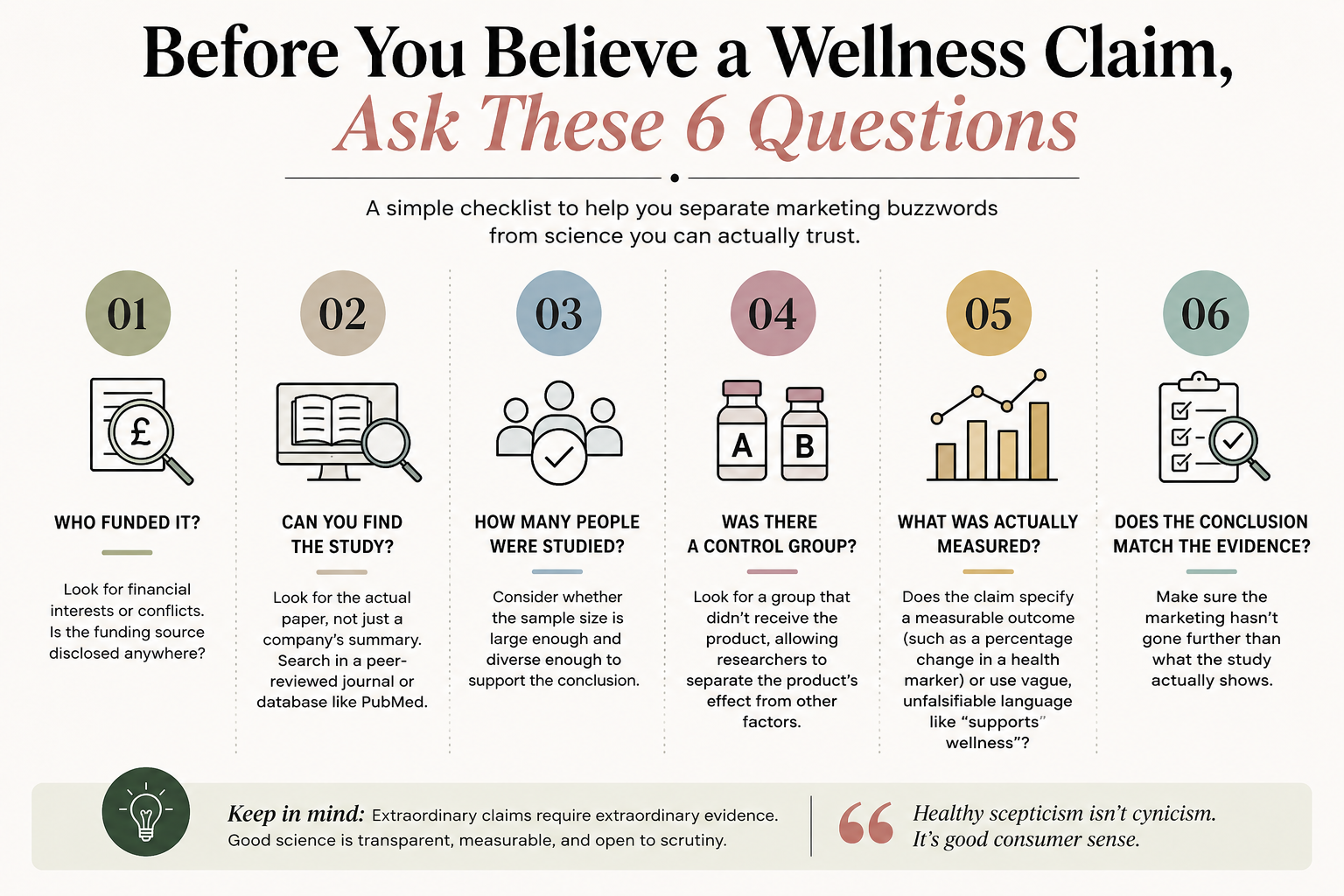
Six Questions to Ask Before Trusting a Wellness Claim
A short list of questions, applied consistently, can cut through most wellness marketing far more effectively than trying to become an amateur scientist overnight.
Who funded the research behind this claim? Is that disclosed anywhere?
Was the study published? Can you actually find the paper in a peer-reviewed journal or databases such as PubMed?
How many people were involved? Was the sample large enough to draw a meaningful conclusion?
Was there a control group that didn't receive the product, allowing researchers to separate the product's actual effect from natural changes, placebo response, or other lifestyle factors?
Does the claim specify a measurable outcome, such as a percentage change in a specific health marker, or does it use vague, unfalsifiable language like "supports wellness"?
And finally, would this claim survive being said plainly, without the polished language? Does "clinically tested" actually mean "tested rigorously and published," or does it just mean "someone tried this a few times and wrote it down"?
None of these questions requires special expertise to ask. They simply require pausing before accepting a confident-sounding phrase at face value.
Practical Ways to Become a More Informed Consumer
Becoming a savvier reader of health claims doesn't mean becoming cynical about wellness altogether. In fact, informed decisions are one of the foundations of long-term well-being. It means applying a bit more scrutiny before adjusting a routine, a diet, or a medicine cabinet based on marketing copy. A genuinely useful habit to develop is to follow the claim back to its source. If a company references a study, search for it directly rather than trusting the summary provided.
Reputable, well-designed research is usually indexed on databases like PubMed and is often described in accessible terms by science journalists or health organisations without a financial stake in the outcome. The same principle applies when reading educational resources about emerging health topics. Resources that explain how measurements, calculations and research procedures actually work can often be more valuable than pages that simply repeat product claims—for example, guides that explain the methodology behind research procedures.
It also helps to notice the difference between anecdote and evidence in your own thinking, not just in advertising. Feeling better after starting a new supplement is real and worth paying attention to, but it doesn't confirm the supplement caused the improvement, especially if other changes happened around the same time. Keeping this distinction in mind makes it easier to evaluate personal experience honestly rather than retroactively treating it as proof.
The Takeaway
Regulatory oversight varies, and that leaves room for vague, confident language to flourish. A little healthy skepticism toward any claim that sounds too clean, too certain, or too good to require real evidence—combined with checking trusted public health sources such as the NHS when evaluating health advice—isn't cynicism. It's simply good consumer hygiene, and in an industry built on optimism and good intentions, it's one of the most valuable habits a reader can bring to the table.
_
John Francis is a health and wellness researcher and writer focused on helping readers make sense of scientific evidence behind emerging health topics. His work explores research findings, study methodology, and the difference between evidence-based information and marketing claims. He is particularly interested in making complex health and scientific subjects accessible, practical, and easier for readers to evaluate critically.


Getting dressed isn’t just about style or trends. Discover how intentional clothing choices can support your body, reduce decision fatigue, and become a daily act of self-respect.